About the Cabinet Office
The Cabinet Office is the seat of the Executive under Bermuda's Constitution. The compound houses the Cabinet Room and the Office of the Premier of Bermuda, who is appointed by the Governor, is an elected Member of the House of Assembly, and is the leader of the majority political party. Also onsite is the Office of the Minister for the Cabinet Office, who since 2025 is also responsible for digital innovation.
Ministers are appointed by the Governor on the advice of the Premier and together form the Cabinet. The Cabinet exercises executive authority under Bermuda's Constitution, meeting weekly to consider Government business, approve amendments to legislation, and authorise the implementation of Government policy. Bermuda's Westminster-style system of government is similar to that in other Overseas Territories and across the Commonwealth.
The Secretary to the Cabinet is appointed by the Governor under the Constitution and serves as the principal policy advisor to the Premier and the Cabinet. The Secretary is responsible for the management of the Cabinet Office and for recording the Conclusions of the Cabinet. The Head of the Public Service, also appointed by the Governor and located within the Cabinet Office, is responsible for the day-to-day management and oversight of the Public Service.
History of the Cabinet Building
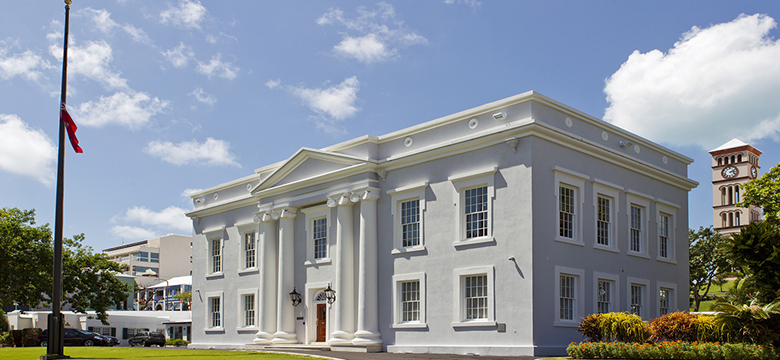
The Cabinet Building was designed in 1837 by an officer of the Royal Engineers then serving in Bermuda. When it first opened in 1884, it was known as The Public Building, housing the Customs and Treasury Departments and the Bermuda Library on the ground floor, with the Council Room and Secretariat above.
The building has served as home to the Council and Secretariat continuously, with the exception of a nine-year period (1969–1977) when the Executive Council was temporarily based at the General Post Office on Church and Parliament Streets. Since 2016, the Senate (successor to the Executive Council) has been housed with the House of Assembly, forming a separate legislative branch under the Constitution.
The entrance door and foyer doors are crafted from Bermuda Cedar, largely from a gift to the Government of Bermuda by the US Consul General, installed during the 1989 renovation. The building today features portraits of all of Bermuda's Premiers since 1968. A 2016–17 renovation added modern presentation and virtual meeting facilities, extended bathrooms, and new catering capacity. A converted meeting room features a Bermuda Cedar board, engraved by former Mayor of Hamilton Mr. Lawson Mapp JP, recording the tenures of Cabinet Secretaries from 1968 to the present.
The Grounds
Immediately beyond the flagpole at the front of the Cabinet Office stands the Cenotaph — Bermuda's memorial to those who died in the World Wars of 1914–18 and 1939–45. The monument is a replica of the Cenotaph in London, built almost entirely of Bermuda limestone. Its cornerstone was laid on 1 October 1920 by HRH the Prince of Wales, who later abdicated the throne as Edward VIII in 1936.
To the east of the building is a granite obelisk erected by the people of Bermuda in memory of Major General Sir William Reid KCB, Governor of Bermuda from 1838 to 1846. Reid is recognised for advancing education, improving agricultural methods, and promoting the general welfare of the island. The inscription at the base reads: "In grateful remembrance of his public service and private worth."
The most recent addition to the grounds is the war memorial (2011), which lists the names of all Bermudians who served in the two World Wars, with an asterisk denoting those who made the ultimate sacrifice. On Remembrance Day (11 November), wreaths are laid at both the Memorial and the Cenotaph by the Governor, the Premier, and the Leader of the Opposition.
The Cabinet Office Lawn is maintained by the Department of Parks and serves as the setting for annual observances including Remembrance Day, the Convening of the Legislature, and the staging point for marching troops during the King's Birthday Parade.
The Sally Bassett Statue
To the west of the grounds stands the Statue of Sarah (Sally) Bassett, a signature piece of public art commissioned by former Premier the Hon. Dame Jennifer M. Smith DBE, DHumL, JP, and created by Bermudian artist Carlos Dowling.
Sarah (Sally) Bassett was an enslaved woman owned by the estate of Francis Dickinson of Southampton. On 1 June 1730, she was tried on the suspicion of poisoning several persons, including mariner Thomas Forster, his wife Sarah Forster, and a household bondswoman named Nancey. Sally maintained her innocence but was convicted and burned at the stake. At the time of her sentencing, she was valued at one pound, four shillings and sixpence.
Local lore holds that it was exceptionally hot on the day of her execution, and Bermudians still refer to a scorching day as "a real Sally Bassett day." Another legend says that Bermuda's national flower, the Bermudiana, grew from her ashes.